


Today, you’ll see Merry People’s bright, colourful gumboots at festivals, on school runs, and at the dog park, but there’s a fascinating history behind the rainboot, which the Duke of Wellington first invented, famed for his Battle of Waterloo victory!
Over the years since the original concept was designed, there have been countless celebrity and cultural influences on gumboot trends, but we’re taking you right back to the beginning to see how these boots came to be.
The Original Rain Boot: How and Why Gumboots Were Designed
Around 225 years ago, outdoor boots were made from calfskins and were about calf height with a short heel. The Duke (an early entrepreneur) wasn’t happy with his boots and wanted something more versatile. He headed into London to have a shoemaker create a customized alternative.
His cobbler raised the boot to the knee, added a wax coating, removed the decorative tassel, and voila, the first interpretation of today’s gumboots was born! At that time, this was a great invention, as it meant boots were tough enough to wear outdoors in the famously rainy English weather, yet also stylish enough to wear indoors.
Understanding the Different Names for the Gumboot
We’ll pause to address a glaring question: what’s the difference between gumboots and rainboots, and why are there so many different names?
In reality, ‘rainboots,’ ‘gumboots,’ and ‘wellies’ are all pretty much the same thing, with Brits referring to them as ‘wellingtons’ (or ‘wellies’) in recognition of their namesake. In Australia, we call authentic rubber boots ‘gumboots,’ after the tree from which the rubber is sourced, whereas ‘rainboots’ is a more modern US term.
How Leather Wellies Became Rubber Gumboots
The next big development occurred in 1852, when Charles Goodyear, whose name you might recognize from Goodyear tires, created a process called ‘sulfur vulcanization.’ This is a process through which rubber is heated to make it flexible enough to mold and shape.
While this was an exciting invention in the world of tires, Goodyear licensed his idea to Hiram Hutchinson in the US, who decided it would be an excellent way to reproduce rainboots from rubber, which he began doing at a mill in France. This idea quickly caught on, and farmers and workers across Europe (and beyond) began swapping leather boots and wooden clogs for rubber boots.
Businessman Henry Lee Norris was also interested in this idea and soon set up a factory in Scotland. His rubber boots became a staple for soldiers during the trenches of World War I, and later, his company was called ‘Hunter Boots,’ a name you’ll probably know!
The Background of the Australian Rubber Gumboot
As these developments continued in Europe, the gumboot was also becoming popular in Australia, which happens to be the part of the world where gum trees are native and plentiful. There are, in fact, more than 900 gum tree species, which made it easy to cultivate as much natural rubber as needed to create another alternative to the fairly new rubber rainboot.
By the mid-20th century, these boots were a go-to for farmers. Of course, the drawback was that the original gumboots didn’t have the advanced comfort features we expect today, and they were available in only one colour: black.
The Evolution of Rubber Rainboots Into Fashion Footwear
Moving into more recent history, the gumboot started to be seen as a cool-but-functional footwear choice on the music and festival scene, with many regarding the UK’s Glastonbury festival as the real catalyst for their popularity. Celebrities like Kate Moss started wearing colourful boots, and designers like Gucci, Dior, and Chanel jumped on the trend, launching their own versions on runways.
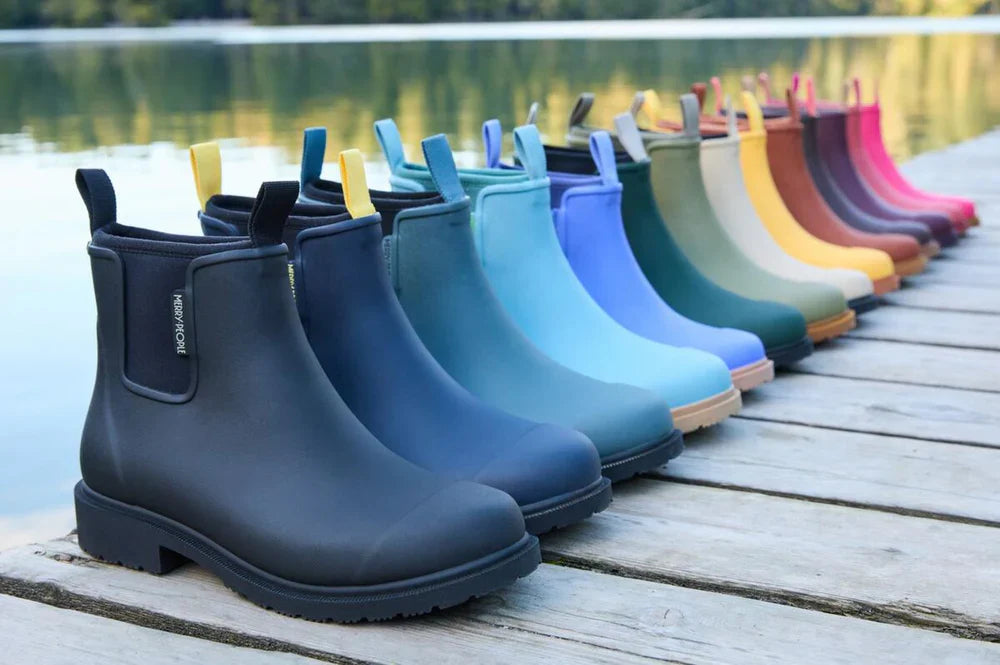
However, the trend stuck, and when Merry People was founded in 2014, it was the perfect time for a new take on the gumboot. We incorporated beautiful shades, versatile styles, and chunky, enhanced-traction soles designed to take on the world.
If we’ve piqued your interest and you want to learn more about how we produce our gorgeous gumboots, you’re invited to join Cass, Head of Product, who will show you how they’re made!
Be sure to check out our selection, as well, to pick out your favourites.
![Bobbi Ankle Boot // Rust [Retired]](http://merrypeople.com/cdn/shop/files/rust-profile_1x_d3cda178-9faa-4959-8224-f8c15850392b.webp?v=1697510502&width=1000)
![Bobbi Ankle Boot // Rust [Retired]](http://merrypeople.com/cdn/shop/files/rust-angle_1x_3a93d3a1-7ea5-4341-aa5f-29a93aec48f6.webp?v=1697510502&width=1000)
![Bobbi Ankle Boot // Slate Grey [Retired]](http://merrypeople.com/cdn/shop/files/slate-grey-profile_1x_11a40dee-6c78-4f1a-aef9-09d91725af67.webp?v=1697510582&width=1000)
![Bobbi Ankle Boot // Slate Grey [Retired]](http://merrypeople.com/cdn/shop/files/slate-grey-angle_1x_05549048-caa5-4409-828e-477a2c75a02c.webp?v=1697510582&width=1000)